Security & audits
Taking over a product from another team? Audit the accounts before the code
It’s natural to start a takeover audit with the code. We start with something duller and more dangerous: who actually owns the accounts your product runs on. Here is the order we check things in, and why.


In short
- A code problem costs you money. An ownership problem can cost you the product. So the first thing we check in a takeover is whose name every account is in.
- You can do the first pass yourself in about an hour, with the checklist below, before you pay anyone.
- Three findings change the plan straight away: backups nobody has restored, keys in the code history, and releases only one person can run.
- Our default is to keep what works. Whether to rebuild anything is a decision for after the audit, made on what it found.
On this page
When a product changes hands, everyone looks at the code. Is it clean, is it documented, will the new team be able to work in it?
Those are fair questions, and we answer them in every audit. But they are not the first ones. The first question is simpler: does the company that paid for this product actually control it?
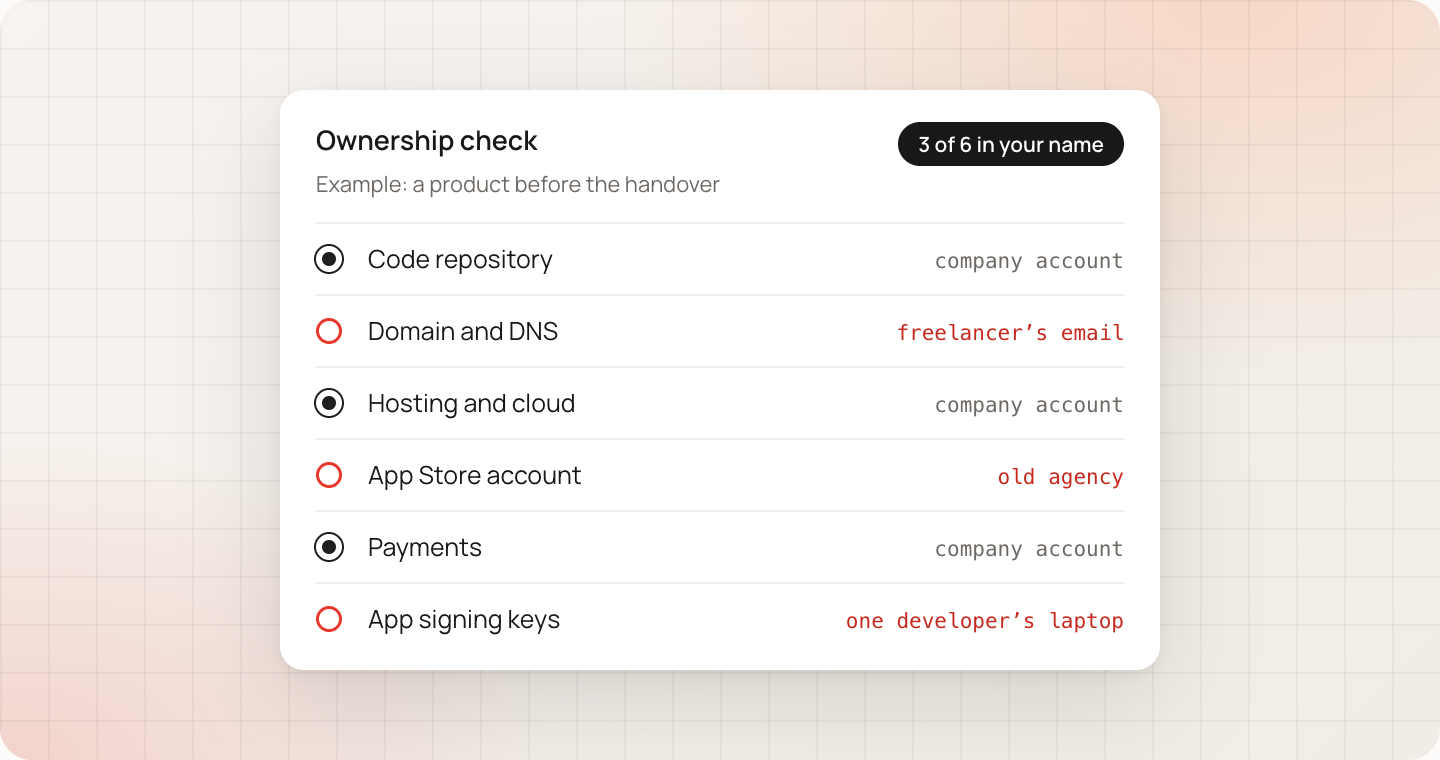
Not always completely. The repository sits in the old agency’s account. The domain was registered with a freelancer’s personal email. The cloud bill goes to someone who left a year ago. None of this shows up in a demo, and all of it becomes urgent the day that person stops answering.
So in a takeover we audit the accounts before the code. Here is how we do it, what we look for after that, and what you can check yourself before calling anyone.
Why ownership comes first
A messy codebase is a cost. You can price it, plan it and fix it step by step while the product keeps running.
A missing account is a different kind of problem. If you can’t log in to the domain registrar, you can’t renew the domain. If the app store account belongs to the old developer, you can’t publish an update. If the cloud account is in someone else’s name, they can switch your product off, by accident or not.
That is why a takeover, for us, starts with a list: every account the product depends on, and whose name each one is in. It is the least technical part of the work, and in our view the most important one.
When someone tells me their product is ready to hand over, my first question isn’t about the code. It’s: who can log in to your domain tonight? The answer tells me how the next month will go.
Takeover checklist: the accounts to check yourself
You don’t need a developer for the first pass. Sit down with whoever holds the passwords today and go through this list. For each line, the goal is the same: the company owns it, and at least two people at the company can log in.
| Account | What to check | If it isn’t in your name |
|---|---|---|
| Code repository (GitHub, GitLab, Bitbucket) | Who owns the organization, who has admin rights | Transfer it to a company account, remove people who have left |
| Domain and DNS | Whose email the registrar account is on, when it renews | Move it to a company email before the next renewal |
| Hosting and cloud | Who the bill goes to, who has the owner role | Move billing and the owner role to the company |
| App Store and Google Play | Whose developer account publishes the app | Transfer the app to the company’s developer account |
| App signing | Who holds the Android upload key and the Apple certificates | Get them into a company vault before anyone leaves |
| Two-factor codes | Which accounts send their login codes to one person’s phone | Add a second company device or move the codes to a shared vault |
| Payments | Who can see payouts and change the keys | Add the company as owner, then change the keys |
| Email delivery and other paid services | Who created the account, where the keys are | Move the account, then change the keys |
| Analytics | Who the admin is | Add a company admin before anyone leaves |
If every line comes back clean, good. If two or three don’t, don’t panic: moving an account is usually paperwork, not engineering. The point is to do it while the old team is still around to help.
What we check after the accounts
Once we know who owns what, we move to the product itself. A full software audit covers six areas, and in a takeover each one answers a practical question.
| Area | The question it answers |
|---|---|
| Security | Who can get in, and what can they see? |
| Code quality | Can a new developer work in it? |
| Architecture | Will it hold as you grow? |
| Servers | Does it stay up, and could you recover? |
| Speed and costs | Is it fast for users, and is the bill sane? |
| Team and process | How will work go from here? |
One check deserves a word of its own, because it is the problem a demo never shows: access rules. A screen may only ever display a user’s own orders. The endpoint behind it may return anyone’s orders if you change a number in the request. Everything looks fine until someone tries. We check the rules where the data lives, not where it is displayed.
Three findings that change the plan
Most of what an audit finds goes into a list, ranked by risk and priced, and gets fixed in order. Three findings jump the queue. When we see one of them, we recommend fixing it before any new feature.
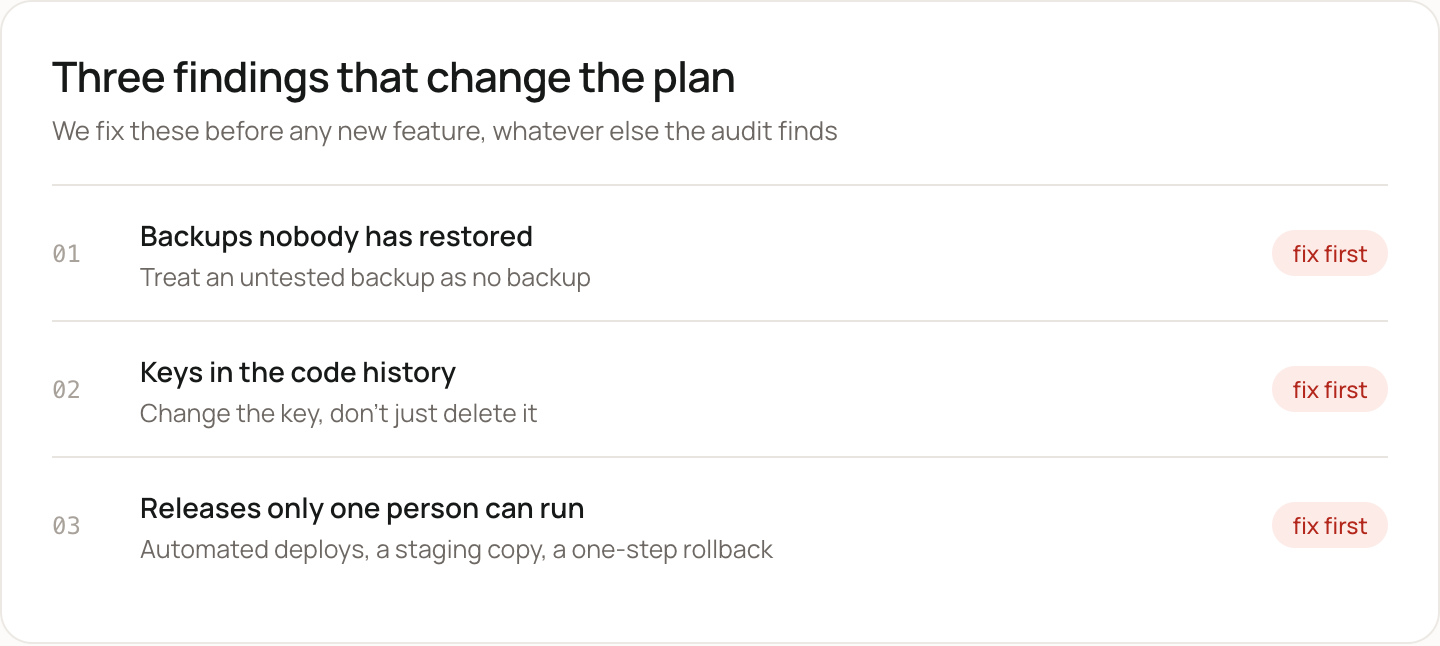
1. Backups that nobody has restored. Having backups and having restored one are different things. Until someone has done it once, you don’t know whether you have a backup or just a file. We treat an untested backup as no backup.
2. Keys in the code history. A developer adds an API key to get something working and means to move it later. Even after it is moved, it stays in the repository history, readable by everyone who ever had access to the code. In a takeover, that includes the team that is leaving. The fix is not to delete it from the code. The fix is to change the key.
3. Releases that only one person can run. If deploying the product means one developer running commands from their own laptop, the product depends on that laptop. When that person leaves, so does your ability to ship. Automated deploys, a staging copy and a one-step rollback come before anything else.
Fix it or rebuild it?
This is the question owners most want answered, and our view is that it can’t be answered before the audit.
A product that frustrates its owner is not necessarily badly built. It may be a reasonable codebase with no tests, no documentation and no one left who understands it. That is a knowledge problem, and a rewrite doesn’t solve knowledge problems. It just creates new code nobody understands yet.
So our default is to keep what works. A rebuild throws away work you have already paid for. We stabilize the product, close the security holes, fix what users hit most and get releases going again. If the audit shows that rebuilding a part would cost less than fixing it, the report says so, with the reasons and the price of each option. That decision is made on facts, part by part, not in the first meeting.
Talk to the old team while you can
If the people who built the product are still reachable, use them. A short call with the outgoing developer answers questions the code can’t: why something was built the way it was, which parts are fragile, what they never got around to. It is easy to arrange before they leave and nearly impossible after.
If they are already gone, we can still start. The code and the servers are enough, and we help you get back anything the old team still holds.
What you get, and what it costs
At the end of an audit you get a written report in plain words, with the technical detail in an appendix for your developers. Every finding has its risk, the fix and what the fix costs. Then we go through it together on a call, so it doesn’t sit in a folder.
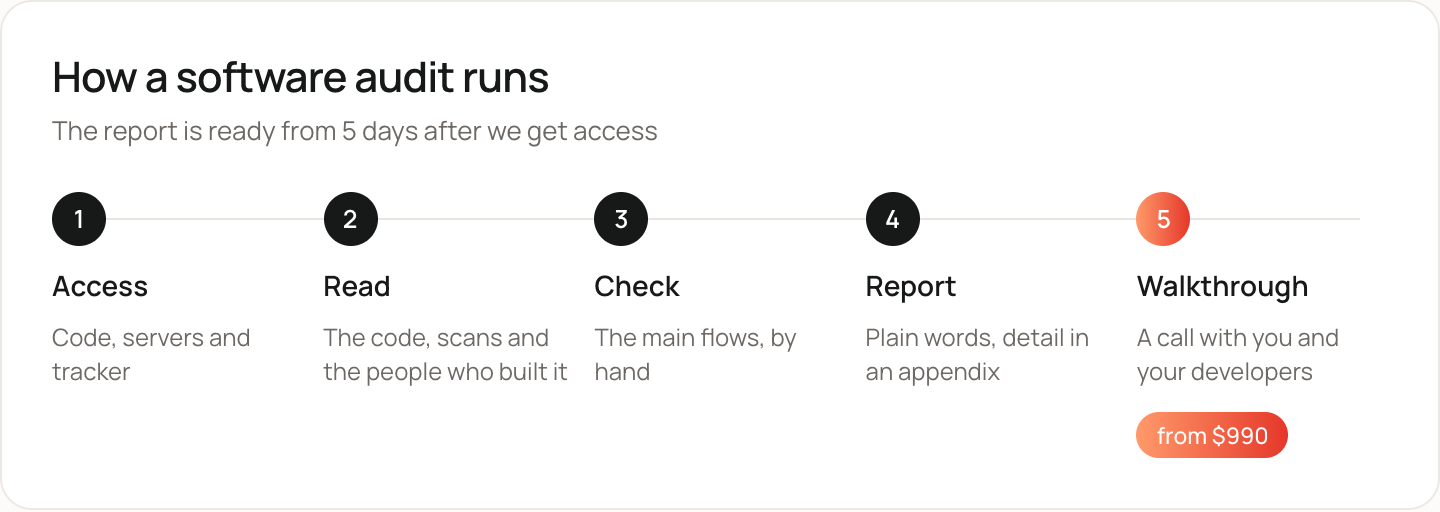
The report is yours. You can fix the findings with us, with your own team or with anyone else. Our audit report is ready from 5 days after we get access, and an audit starts from $990, depending on the size of the product and how deep the security checks go.
If you want us to take the product over afterwards, the takeover picks up straight from the report. Its first stage starts from $3.5k, and the first release with us goes out from 2 weeks.
Questions
What should I check before I hire a new team?
Start with the accounts: the code repository, domain, hosting, app store accounts and signing keys, payments and any paid service with a key. Make sure each one is in the company’s name and that at least two people at the company can log in. The checklist above covers the usual ones.
What if the old developer won’t hand over access?
We can still start. With the code and the servers we work out the rest ourselves, and we help you get back anything the old team still holds.
How long does a software audit take?
Our report is ready from 5 days after we get access to the code, the servers and the task tracker. A larger product with several apps, or one that needs manual security testing, takes longer. You get the date before we start.
Do you need the old team to be involved?
No, but it helps. We can audit a product from the code and the servers alone. A short call with the people who built it answers questions the code can’t, so we suggest it whenever they are still around.
What access do you need?
Read-only access to the code, the server settings and the task tracker is enough, and we ask before touching anything else. At the start we agree what matters most to you, so the audit checks that first.