





Legacy modernization

We move your aging web product to a modern stack part by part, while your users keep working in it.

Old codeOnline the whole timeModern stack
30,000+
learners on a platform we built
300+
projects since 2014
12
years of shipping web apps, SaaS and mobile
NDA
signed before you share anything sensitive

Clients we’ve built for

Where you’re starting from

Every older product has aged in its own way. These are the four situations we see most often.

Your product works, but every new feature costs more

A small change takes weeks, and something always breaks somewhere else.

What we do
We assess the code, the data and the hosting, and move the part that holds you back most first.
What you get
You see the difference after the first part, not at the end of the project.
Your framework or server is no longer supported

No security patches, new libraries won’t install, and developers for the old version are hard to find.

What we do
We move the product to a current framework and cloud hosting part by part, with all its data.
What you get
Security patches as they come out, and a stack you can hire for.

One person knows how the system works, and there’s no documentation

What we do
We work it out from the code and from the people who use the product, and put tests around the parts that matter.
What you get
Code any new developer can follow.

You’re thinking of rewriting it from scratch

What we do
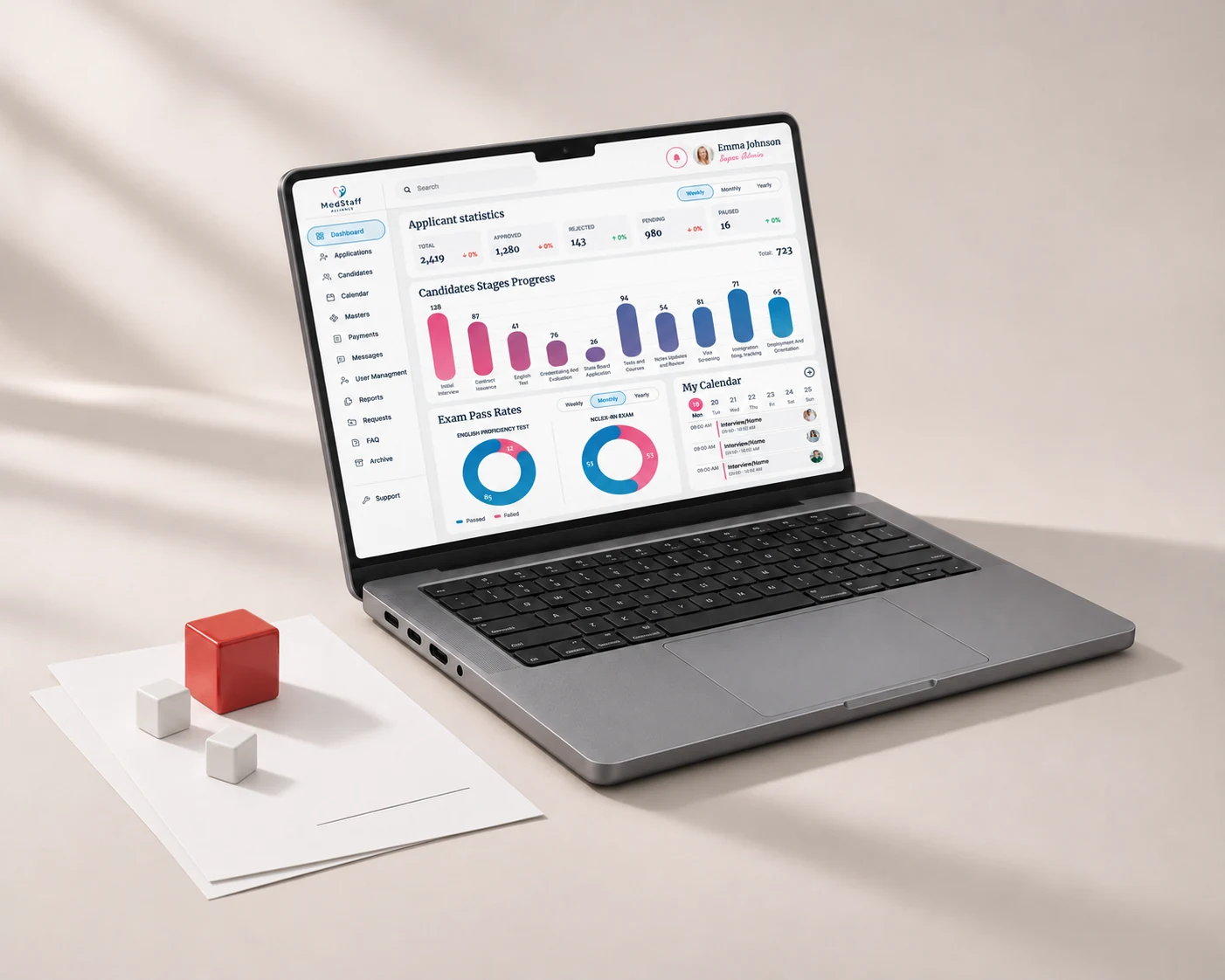
First we assess the product and tell you which pays off: moving it in parts or rebuilding it. Usually it’s in parts: old and new work as one product, and new features go straight into the new stack. If we rebuild, we carry over what the old system does, not its code, as we did for Medstaff.
What you get
A decision based on the code and the data, not a guess. The business rules buried in the old code don’t get lost on the way.

Case study

What we modernize

Today

  • No security patches for the version you run
  • New libraries won’t install
  • Few developers want to work with it
  • Upgrades put off year after year

After

  • A current, supported framework
  • Security patches as they come out
  • Libraries that install and update cleanly
  • A stack you can hire for

Today

  • One codebase where everything depends on everything
  • Small features take weeks
  • Nobody dares to touch the core
  • One person knows how it all works

After

  • Separate parts with clear boundaries
  • Changes that stay inside one part
  • Tests around the parts that matter
  • Code any new developer can follow

Today

  • A server set up by hand years ago
  • Releases done by hand, late at night
  • Outages when traffic spikes
  • A hosting bill that only grows

After

  • Cloud hosting set up in code
  • Releases in minutes, at any hour
  • Room to grow at peak times
  • A bill that matches what you use

Today

  • Tables nobody can explain
  • The same data stored in several places
  • Reports that take hours to run
  • Fear of losing data with every change

After

  • A structure that fits the product today
  • Each record stored once
  • Reports that run in seconds
  • Room for the features you have planned

Today

  • Users leave before the page opens
  • Queries that slow the whole product down
  • Search and filters that crawl
  • Fixes that only buy a few months

After

  • Pages that open fast on any connection
  • Slow queries rewritten
  • Caching where it pays off
  • Speed checked before every release

Today

  • Screens built for a desktop monitor
  • Pages that reload on every click
  • A different style on every screen
  • Forms users give up on

After

  • A layout that fits any screen
  • Screens that update without reloading
  • One design system across the product
  • Shorter forms that people finish
Linda Zidu, Chief Operating Officer at Redlab

Start with a 30‑minute call

Talk to Linda Zidu, our COO, about your product, what holds it back and your plans. We’ll suggest the first step that gives you the most clarity.

In 30 minutes we cover

  • Your product and what holds it back most
  • Where to start: a plan or the move itself
  • Timeline, price and next steps
Book a call NDA before you share anything sensitive

How modernization works

At every step you know what’s happening, what you get and what it costs.

  1. 01

    Assessment

    We study the code, the data and the hosting, and rank each part by how much it holds you back.

    You getA list of what to move first.

    Risk it removesStarting the move with the part that matters least.

  2. 02

    Foundation

    We set up the new stack and connect it to the old one.

    You getOld and new working as one product.

    Risk it removesThe product stopping during the move.

  3. 03

    First part

    We move the part that holds you back most, so you feel the difference early.

    You getThe first part on the new stack.

    Risk it removesMonths of work before you see any result.

  4. 04

    The rest

    Each part moves with its data and is checked against the old version before release.

    You getImprovements release by release.

    Risk it removesLosing data, or the business rules buried in the old code.

  5. 05

    Switch-off

    We turn off the old system once nothing depends on it.

    You getOne product on a modern stack.

    Risk it removesPaying for two systems for years.

    Support & maintenance

  6. Start with a short brief

    A few lines or a link is enough. Linda replies within 12 hours.

    Tell us about your product →

Two ways to start

Either way, you can stop after any step and keep what’s done.

Option 1

A modernization plan

You get
A written plan with the order of work and the cost of each step.
Then
Do the work with us, with your own team or with anyone else. The plan is yours.

Option 2

Full modernization

You get
The plan, then the whole move, from the first part to the last.
Then
Keep building the product with us, or take it in-house.

What modernization costs

  • Size of the appMore modules and screens mean more parts to move.
  • DataCleaning or restructuring data on the way is separate work.
  • IntegrationsEach outside system the app talks to needs its own move and tests.
  • HostingMoving to new hosting or the cloud is separate setup.

Recognition

Recognized by juries. Rated by clients

Twelve design awards for the websites we built, and a 5.0 rating from 36 client reviews on Clutch.

  • ZeussTelehealthVerified on Clutch

    “No platform supports asynchronous telemedicine with e-commerce, so it had to be custom built. The site is working great and driving sales and revenue.”

    A US telehealth brand needed a platform from medical intake to monthly subscriptions, with state and lab checks before anyone pays. Redlab built it on WordPress and Paid Memberships Pro. Zeuss case

    Jonas SiukstaFounder & CEO
  • MarTech Co.Advertising & marketingVerified on Clutch

    “They take initiative, do their own research, and come back with well-thought-out solutions.”

    MarTech Co. needed a scalable SaaS platform that manages several user levels and connects to a growing set of third-party APIs. Redlab built it and has kept improving it since May 2020. The CEO points to a team that researches problems on its own and arrives with solutions, not questions.

    CEOName withheld on Clutch
  • HexagonCrypto educationVerified on Clutch

    “…approached the project not just as developers, but as a true product partner.”

    Hexagon’s design team needed engineers to turn their designs for a crypto learning platform into a working product. Redlab built the front end and back end, including Web3 sign-in and payment integration. The co-founder describes the team as a product partner rather than a pair of hands. Learncrypto case

    Dmytro BoychukCo-Founder
  • Status Verification Co.Consumer servicesVerified on Clutch

    “They really get the job done.”

    The company needed iOS and Android apps with map features and an admin CMS to run the content. Redlab delivered launch-ready apps and kept pace as the requirements changed during the project. The work started in June 2024 and continues.

    Madeleine MacDonaldMarketing Lead
  • OAKWELLDay spaVerified on Clutch

    “They approach obstacles as shared problems, not client problems.”

    Oakwell, a day spa, needed a responsive website with online booking that works with the tools the team already uses. Redlab built the site, improved the admin panel and connected several third-party services. The CEO values a team that treats obstacles as shared problems.

    Damien ZouaouiCEO & President
  • Rapide YachtYacht brokerageVerified on Clutch

    “…delivered measurable results in terms of increased website traffic, leads, and user engagement.”

    Once the new design was ready, the yacht brokerage needed custom development to bring it to life. Redlab built the site with custom functionality on WordPress. Since launch, the founder reports more website traffic, more leads and higher user engagement.

    FounderName withheld on Clutch
  • SoftButlerQA servicesVerified on Clutch

    “…helped simplify the structure and present our services in a way that makes more sense.”

    SoftButler, a QA services company, needed a site that explains what it offers. Redlab worked out the structure and content, designed the site and built it, front end and back end.

    Yevhenii IhnatkinQA Automation Engineer

When we’re the right team

Worth knowing before the first call, for you and for us.

We’re a good fit if

  1. Your product makes money and people use it every day, so you can’t stop it for the move.
  2. You want to move in parts and see a result after each one.
  3. You need a plan you can keep working from, with us, with your own team or with anyone else.

Sounds like you?

Tell us about your product

We’re probably not the right team if

  1. You want everything rewritten from scratch and released in one day.
  2. You need an urgent move in a few days, without assessing the code, the data and the hosting.

Questions about legacy modernization

Something else? Write to hello@redlab.agency.

How much does legacy modernization cost?

The plan starts at $2.5k. The move itself is priced part by part from the plan, and you pay for each part before it starts.

How long does modernization take?

The plan takes from 2 weeks. How long the move takes depends on what we find in the code, the data and the hosting, so the plan gives a timeline for each part.

Will the product stop during the move?

No. Old and new parts work as one product, and your users keep working in it.

Can we keep adding features during the move?

Yes. New features go straight into the new stack, so your roadmap keeps moving.

Why not rewrite it from scratch?

For a product people use every day, a rewrite stops new work for months, and the business rules buried in old code tend to get lost on the way. Sometimes rebuilding really does pay off, and the assessment shows when.

Do we need documentation for the old system?

No. Most older products have little of it. We work it out from the code and from the people who use the product.

Can you take over a product another team built?

Yes, that’s the usual case. We start by assessing the code, the data and the hosting.

Can our own team do the move?

Yes. The plan is yours: work from it with us, with your own team or with anyone else.

Who owns the code?

You do. The code, the repository, the hosting and every login are in your name.

Will you sign an NDA?

Yes. We sign yours or send ours before you share any details.

Tell us about your product

A few lines or a link is enough.

What happens next

  1. 01Within 12 hours a person replies, with questions or a time for a call.
  2. 02A call. We get into your task and your goals.
  3. 03A proposal for the modernization plan, with its timeline and price. We sign an NDA before you share the details.

Linda Zidu COO · answers every request

Book a call

How should we address you?

Add an email we can reply to.

Tell us a little more: at least 50 characters.

    The stack we move you to