A marketplace for live
personal training
AIM matches clients with a coach and lets them train together live by video. We developed it from the ground up: the mobile apps, AI matching, video, an Apple Watch app and the CRM behind the business.
- Industry
- FitnessMarketplaceAI
- Our role
- Development: iOS and Android apps, backend, video, AI, Apple Watch, CRM
- Stack
- React Native, Node.js, mediasoup

About the project
Summarize this case with AI
AIM is an online fitness marketplace for live, one-to-one personal training. Coach discovery, booking, payments and the workout itself happen in one app.
We did the mobile app development in React Native for iOS and Android, built the Node.js backend and the systems behind the service: AI matching, custom video, an Apple Watch app, web-to-app onboarding, analytics and a CRM.
Challenge
Make personal coaching easier to find and trust
AIM’s founders came to us with an idea: an online marketplace that connects clients with vetted trainers for one-to-one sessions. Clients would explore profiles and reviews, choose someone who fits their goals and train with a coach who watches their movement and guides each workout in real time.
Trainers needed a place to present their expertise and run sessions, and the founders needed tools to manage clients, trainers, bookings and payments. Our brief covered both: the apps for online training and the systems to run the marketplace.

01 · AI coach matching
From practical fit to three recommendations
Matching starts with practical fit: goals, fitness level, format, budget, language, time zone and free slots. We built a hybrid recommendation system that gives each trainer a percentage score from the client’s goal and level, the trainer’s specialization and experience, and their communication style.
The ranking also weighs how often clients renew with a trainer, how fast they reply and how often they update programs, and collaborative filtering adds what similar clients chose. A language model then reviews the 8–12 best candidates and picks three. After the first workout AIM asks how it went and can suggest someone else.

02 · Booking
Booking built around real schedules
We built AIM’s booking with rescheduling and cancellations. As soon as a client picks a slot, AIM holds it for a limited time and hides it from other clients while the first one finishes booking.
If the booking isn’t completed in time, the slot is released automatically. The client’s choice is protected, and abandoned bookings don’t block a trainer’s time.

03 · Payments and reminders
Payments, calendar and notifications
Clients pay for training inside AIM. Calendar integration and push notifications carry the schedule beyond the booking screen, so people keep track of their sessions.

04 · Live video
Live training on custom video infrastructure
Live video is where AIM delivers its service. After looking at managed video services, we built AIM’s calls on mediasoup, an open-source WebRTC media engine. Its low-level API let us shape calling around the product and run the media layer on infrastructure chosen for AIM.
Managed services usually charge per participant minute. With mediasoup, AIM pays for its own hosting and bandwidth instead, and has a base for planned session recordings and group calls. The trade-off is more engineering and operations work for the team.

05 · Apple Watch
An Apple Watch app for live training
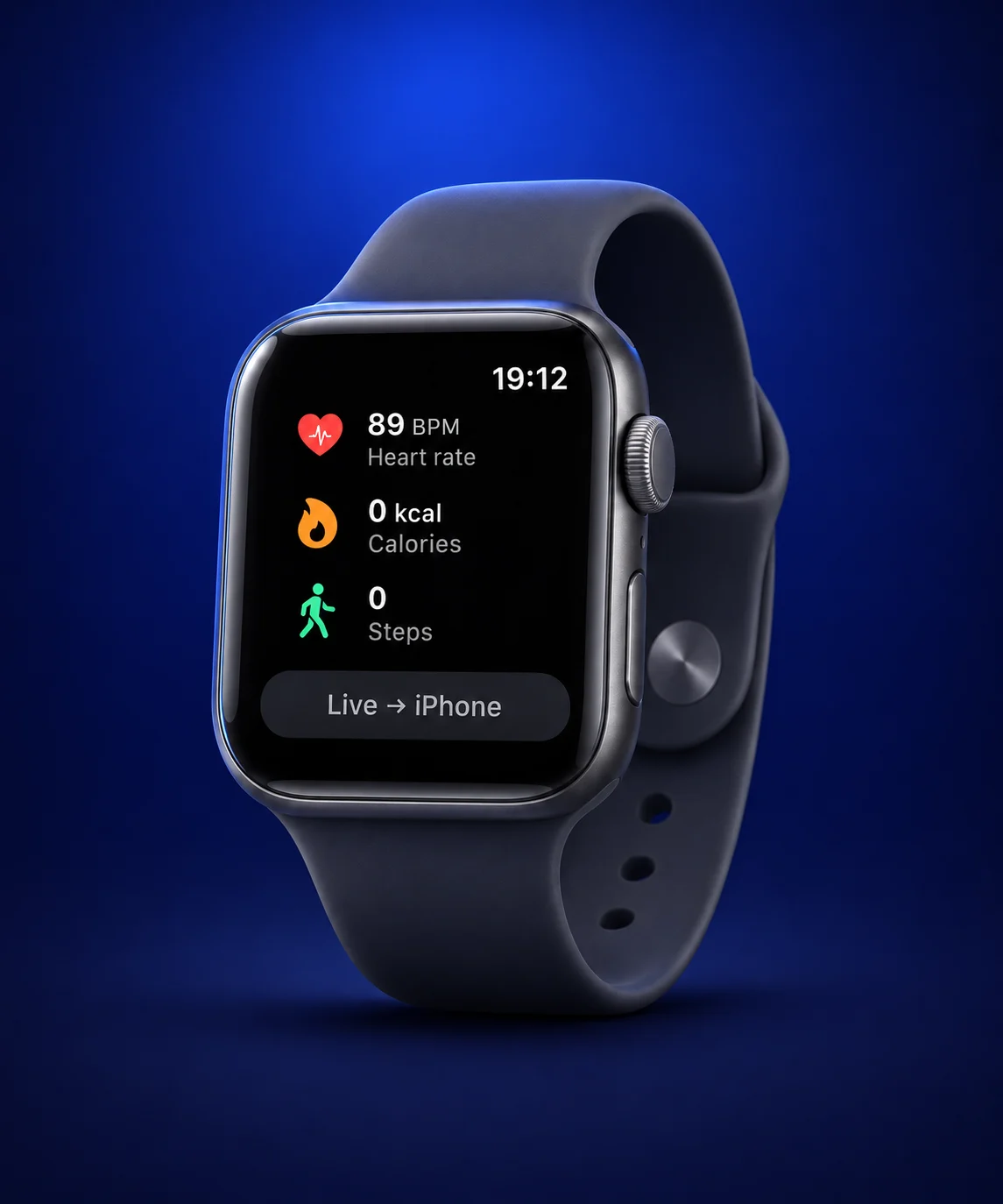
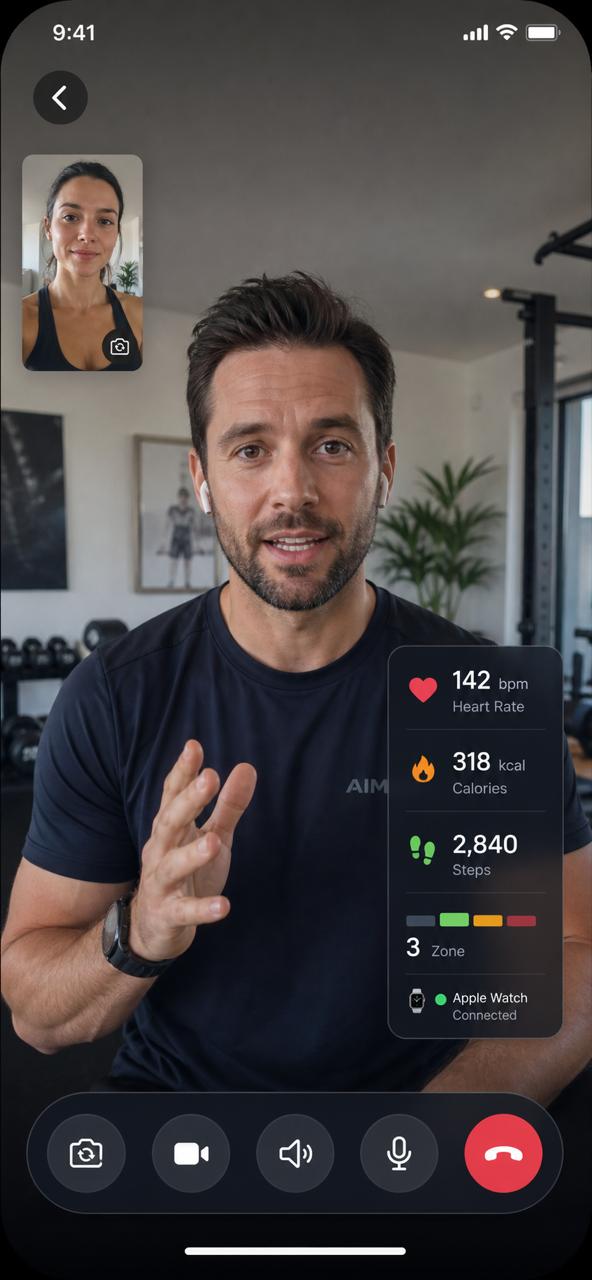
We built AIM’s Apple Watch app. The client wears the watch, and the trainer sees their heart rate, calories and step count during the live video session.
We brought the watch data into AIM’s own video screen, so coaching and activity data sit side by side.
06 · Chat
Trainer and client chat with AI moderation
Coaching continues between sessions, so we built chat between trainers and clients inside AIM.
AI moderation removes contact details and profanity from messages, applying AIM’s rules on sharing outside contact details.

07 · Web-to-app onboarding
Choose a coach and pay before installing
The acquisition flow is built for people arriving from Meta and other social ads, often inside a social app’s browser. We brought the app’s onboarding to mobile web: a landing page leads into the same quiz as the app, with name, weight, goals and trainer preferences. People choose a coach, register with Google or Apple and pay on the web.
After installing AIM they sign in the same way, and their data and purchases are already there. AppsFlyer links attribute each sign-up to its campaign. Google Analytics tracks the quiz screens and key onboarding stages and Firebase covers app events, so the team sees where people drop out.

08 · CRM
A custom CRM for running the marketplace
We built AIM’s CRM around the daily work of a fitness marketplace: clients, trainers, bookings and payments in one place, so the team can support people and manage the business.
01Dashboard
Client and trainer counts, activity, completed sessions and sessions happening right now, with retention, churn, revenue per client, acquisition cost, active subscriptions and lifetime value for 1, 3, 6 or 12 months.
02Client and trainer records
Each client’s profile, past and upcoming sessions, trainers, subscriptions and chats; each trainer’s clients, sessions and earnings.
03Payouts
Each trainer’s monthly earnings, prepared for payout, and the history of payouts already made.
04Session logs
Connection events, connection quality, start, pause and end, and camera activity, so support can rebuild what happened when someone reports a problem.
05Notifications
Custom push messages to chosen clients or trainers, or to everyone, for news and reactivation.
Technology
The stack behind AIM
Mobile apps in React Native on a Node.js backend, with video on mediasoup.
Mobile
React Native apps for iOS and Android, and an Apple Watch app.
Backend
Node.js.
Video
mediasoup, an open-source WebRTC media engine.
AI
Hybrid trainer scoring with collaborative filtering and a language model for the final shortlist; AI chat moderation.
Analytics
AppsFlyer, Google Analytics and Firebase.
Results
From a startup idea to a working marketplace
AIM went from an idea to a working platform for live personal coaching. Clients find a trainer, pay and train live, and the AIM team supports those relationships and runs the business from its own CRM.
- 4.9rating on the App Store
- 200+trainers registered in the first week after launch
Our team
The people who built AIM’s apps, video and backend.
4 specialists- 1
Project manager
Planning and delivery
- 1
Tech lead
Architecture and code review
- 1
Mobile developer
iOS and Android apps in React Native
- 1
Backend developer
Backend, video and integrations
Redlab built our app and the CRM behind it. Video calls were the hardest part, and they handled it without drama. Coaches and clients now meet face to face right in the app, and that’s usually the first thing people mention about AIM.
They treated AIM like their own product. When something didn’t make sense for our users, they said so, and usually came back with a simpler way to do it. Honestly, we’re really happy with how it turned out, and with the team. We’d work with them again.
Questions about AIM
Case study by Redlab · Updated
What is AIM?
AIM is an online fitness marketplace for live, one-to-one personal training. Clients choose a coach from trainer profiles, book and pay, and train live by video in the app.
What did Redlab build for AIM?
We developed AIM from the ground up: iOS and Android apps in React Native, the Node.js backend, AI coach matching, booking and payments, custom video calling on mediasoup, chat with AI moderation, an Apple Watch app, web-to-app onboarding, analytics and a custom CRM.
How does AIM’s AI coach matching work?
It is a hybrid recommendation system. Each trainer gets a percentage score from the client’s goal and level, the trainer’s specialization and experience and communication style, plus renewal rate, response speed and how often programs are updated. Collaborative filtering adds what similar clients chose, and a language model picks three trainers from the 8–12 highest-ranked.
Why did AIM use mediasoup for video?
For control and cost. mediasoup is an open-source WebRTC media engine with a low-level API, so the calling experience is shaped around the product and the media layer runs on AIM’s own infrastructure, without a license fee per participant minute. The trade-off is more engineering and operations work for the platform team.
What does the AIM Apple Watch app do?
The client wears the watch during a live session, and the trainer sees the client’s heart rate, calories and step count right on the video call screen.
How does AIM stop two clients from booking the same slot?
When a client selects a slot, AIM holds it for a limited time and hides it from everyone else. If the booking isn’t completed in time, the slot is released automatically.
How is chat moderated on AIM?
AI moderation removes contact details and profanity from messages between trainers and clients, applying AIM’s communication rules inside the chat.
Can people sign up for AIM before installing the app?
Yes. People arriving from social ads take the same quiz as in the app on mobile web, choose a coach, register with Google or Apple and pay. After installing AIM they sign in the same way and find their data and purchases in the app.
What does the AIM CRM do?
It runs the marketplace: a dashboard of activity and business metrics, full client and trainer records, monthly trainer earnings prepared for payout, a log of every session’s technical events and custom push notifications.
What results has AIM achieved?
A 4.9 rating on the App Store, and more than 200 trainers registered in the first week after launch.
Can Redlab build a coaching marketplace or fitness app?
Yes. We build mobile apps with booking, payments, live video and the business systems behind them. See mobile app development, or tell us about your product below.
More products we’ve built
Tell us about your product
A few lines or a link is enough — we’ll come back with questions and a first view of scope.

Thank you
Linda has your request. Expect a reply within 12 hours — with questions, or a time to talk.